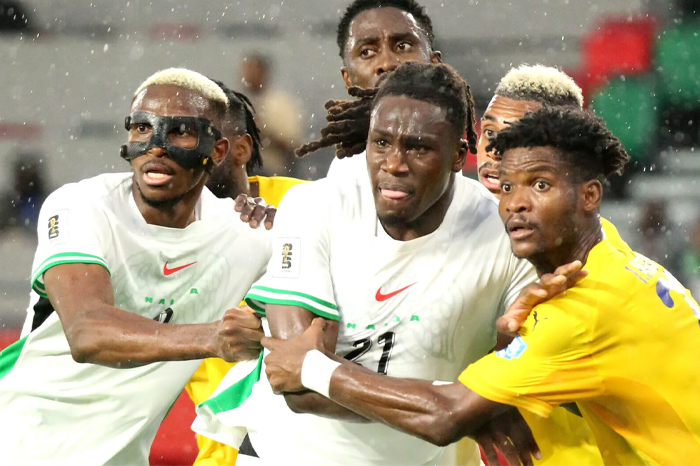
Nigeria’s 4-3 penalty shootout defeat to DR Congo in Rabat has left a footballing nation stunned. A two-year qualifying journey, full of twists, managerial changes and late revivals, ended with the Super Eagles once again falling short of the World Cup.
The pain cuts deeper when you consider the calibre of this squad. By the time the 2030 World Cup arrives, a golden era of Nigerian talent is at risk of passing without ever stepping onto football’s biggest stage.
How old some Super Eagles stars will be by the time Nigeria could next play at a World Cup in 2030…
— Bet9ja: The home of #betBOOM! ? (@Bet9jaOfficial) November 17, 2025
Nwabali – 34
Troost-Ekong – 36
Ajayi – 36
Aina – 34
Ndidi – 33
Iwobi – 34
Lookman – 32
Osimhen – 31
Simon – 35
Chukwueze – 32
Huge opportunity lost ??? pic.twitter.com/Q5NTVindVs
Yesterday’s defeat to DR Congo only emphasised the frustration. Nigeria started brightly through Frank Onyeka’s deflected strike, but after Meschack Elia levelled, the Super Eagles struggled for control and rarely looked like finding the winner. Once Osimhen departed at half-time, the attacking threat faded.
It was a bitter ending to a qualifying campaign marked by inconsistency – and the setback also forces the most important question of all: what now?
Running out of time
Only four members of the current squad were at the last World Cup Nigeria reached in 2018. For the rest, the door to the tournament may already be closing. Osimhen, the best striker in Africa, may never get to showcase his peak years on the world stage. Ndidi, Iwobi, Chukwueze, Simon and others will be past their prime by 2030. It is one of the biggest talent pools Nigeria has produced in decades, but it risks being remembered for what it never achieved.
The heartbreak in Morocco should signal a turning point. The Super Eagles do not lack talent, but they must now start looking forward with clarity and purpose.
The next generation
Despite the concerns, there is genuine hope. Nigeria’s U20 team reached the U20 World Cup final, demonstrating that the talent pipeline still has life. The emergence of Benjamin Fredrick, who held his own on the biggest stage despite playing in the NPFL just two years ago, shows that local development can still produce elite players.
The next phase must be about building a structured pathway from youth football into the senior national team, ensuring that young talents do not disappear in the gaps between academies, clubs and national-team selection. The raw talent exists. It simply needs nurturing, protection and long-term planning.
Diaspora recruitment
The global spread of Nigerian talent is one of the country’s greatest advantages – but only if it is maximised. Around Europe, several elite young players are eligible for Nigeria and could reshape the future of the Super Eagles if convinced early. Such as:
- Noah Atubolu (23, Freiburg)
- Caleb Okoli (24, Leicester)
- Michael Kayode (21, Brentford)
- Ethan Nwaneri (18, Arsenal)
- Lesley Ugochukwu (21, Burnley)
- Carney Chukwuemeka (22, Dortmund)
- George Ilenikhena (19, Monaco)
This is where the NFF must act decisively. With the right communication, long-term planning and player integration, Nigeria can reshape its identity and usher in a new era.
As sassy as you like, George Ilenikhena ??? pic.twitter.com/Y6lFwvQ6mA
— Ligue 1 English (@Ligue1_ENG) September 18, 2025
Rebuild – not retreat
Sunday’s defeat hurt, but it also clarified what is needed. A stronger talent pipeline. A strategic diaspora recruitment plan. A clearer football identity. A long-term vision that outlasts individual matches, tournaments or managerial changes.
Nigeria’s footballing potential remains enormous. The passion is unmatched. The talent pool is global. The demand for success is permanent. But the next step requires structure, cohesion and belief.
This generation may not reach the World Cup. But the next generation can – if Nigeria starts building for tomorrow today.
The Super Eagles World Cup dreams may be over, but it’s just over a month until our AFCON campaign begins! You can back the boys to lift the trophy here.