
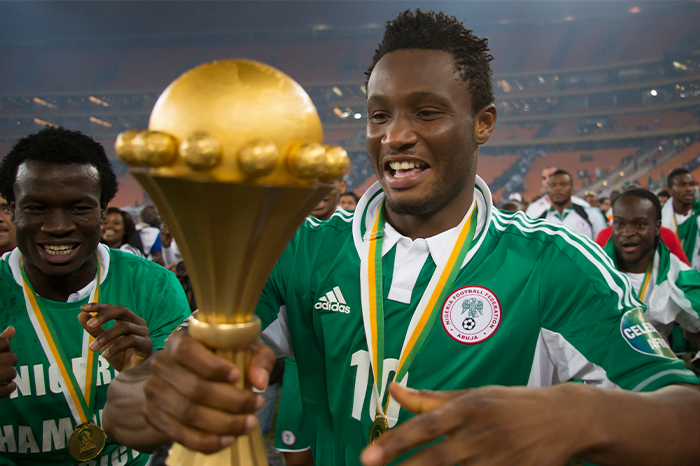
Few nations in African football can boast a legacy as deep, dramatic and enduring as Nigeria’s at the Africa Cup of Nations.
From the jubilation of Lagos in 1980 to the emotion of Tunis in 1994 and the rebirth in Johannesburg in 2013, the Super Eagles have spent decades shaping the story of African football.
Nigeria have lifted the AFCON trophy three times in their history: 1980 on home soil, 1994 in Tunisia and 2013 in South Africa. They have finished runners-up five times, more than any other nation, and their eight bronze medals are also a tournament record.
For a team that has consistently been among the continent’s elite, the recurring theme has often been one of what might have been. Yet every era has delivered heroes, memories and milestones that shaped the Super Eagles’ identity in African football.
New tournament. Same goal ?
— Bet9ja: The home of #betBOOM! ? (@Bet9jaOfficial) May 20, 2025
Bet9ja are proud to be the official sponsor of @NGSuperEagles 2025 AFCON campaign!
Let’s Do It Again, Super Eagles ??? pic.twitter.com/4V91lWcCSN
Nigeria’s first taste of continental glory: AFCON 1980
Nigeria’s breakthrough came in 1980, a moment still remembered as one of the most emotional nights in the country’s sporting history. Playing in Lagos under Brazilian coach Otto Gloria, the Green Eagles stormed to the title with Segun Odegbami, Muda Lawal and Adokiye Amiesimaka leading the way. A 3-0 victory over Algeria in the final ignited celebrations across the nation.
Players recalled the reception that followed as something they had never experienced. From parades to gifts from the government and private companies, the victory transformed the squad into national icons. Christian Chukwu, who lifted the trophy as captain, described the feeling as “riding like a king” through the streets of Lagos. It was the moment Nigeria truly arrived on the African stage.
The rise of a powerful football nation
Throughout the 1980s and early 1990s, Nigeria became a permanent fixture at the top end of the competition. They suffered narrow defeats in the 1984, 1988 and 1990 finals, with each runner-up finish deepening the hunger for another title. Despite those setbacks, the foundations were being laid for a golden era.
The Golden Generation delivers: AFCON 1994
Nigeria’s long wait for a second championship ended in 1994 in Tunisia, a year that would define the nation’s football identity. Led by Rashidi Yekini, Jay-Jay Okocha, Sunday Oliseh, Ben Iroha and Emmanuel Amunike, the Super Eagles powered through the tournament with confidence and flair.
After beating Zambia 2-1 in an emotional final, Nigeria were crowned champions for the second time and cemented their reputation as one of the continent’s true powerhouses. Yekini finished as top scorer, while the team’s performances earned widespread admiration. It was a tournament that showcased Nigeria’s most talented generation and created legends whose influence still shapes Nigerian football today.
The wait ends again: AFCON 2013
Nearly two decades after the triumph of 1994, Stephen Keshi led a new-look Super Eagles to their third African title in South Africa. The team did not start the tournament smoothly, drawing their opening two matches and facing heavy criticism back home. Behind the scenes, tensions and disagreements tested the unity of the squad.
Keshi’s leadership became the turning point. His calm response to dressing-room confrontations allowed the players to reset and refocus, eventually growing stronger with each game.
Nigeria defeated star-studded Ivory Coast in the quarter-finals, overwhelmed Mali in the semis, and edged Burkina Faso 1-0 in the final thanks to Sunday Mba’s iconic winner. It was a hard-earned triumph that revived national pride and confirmed Keshi as one of Nigeria’s greatest football figures.
Heartbreak and near-misses
Nigeria’s history at AFCON is intertwined with near misses and painful defeats. No country has finished as runners-up more often. The defeats in 1984, 1988, 1990, 2000 and 2023 each carried their own emotional weight.
The 2000 final, co-hosted by Nigeria, ended in heartbreak on penalties against Cameroon. In 2023, the Super Eagles reached the final again but were undone by a revitalised Ivory Coast side.
Yet even in disappointment, Nigeria produced iconic moments, from Julius Aghahowa’s late goals in 2000 to Stanley Nwabali’s penalty shootout heroics in 2023.
We're bringing back this video made with the @NGSuperEagles for AFCON 2023
— Bet9ja: The home of #betBOOM! ? (@Bet9jaOfficial) October 14, 2025
Remember who we are: Africa's ELITE ?? pic.twitter.com/ACnP00cGTQ
Nigeria’s AFCON journey in context
From the foundation of the tournament until now, Nigeria have demonstrated longevity, resilience and brilliance across generations. The titles of 1980, 1994 and 2013 represent national milestones. The heartbreaks of 2000 and 2023 show how close Nigeria have come to even greater dominance.
As AFCON 2025 approaches, the Super Eagles once again carry the expectations of millions. Under Eric Chelle, the goal is simple: to finally claim a fourth African crown and restore Nigeria’s place at the top of the continent.
Nigeria AFCON History by Year
| 1963 | Ghana | Group stage |
| 1965 | Tunisia | Withdrew |
| 1968 | Ethiopia | Did not qualify |
| 1970 | Sudan | Withdrew |
| 1972 | Cameroon | Did not qualify |
| 1974 | Egypt | Did not qualify |
| 1976 | Ethiopia | Third place |
| 1978 | Ghana | Third place |
| 1980 | Nigeria | Champions |
| 1982 | Libya | Group stage |
| 1984 | Ivory Coast | Runners-up |
| 1986 | Egypt | Did not qualify |
| 1988 | Morocco | Runners-up |
| 1990 | Algeria | Runners-up |
| 1992 | Senegal | Third place |
| 1994 | Tunisia | Champions |
| 1996 | South Africa | Withdrew |
| 1998 | Burkina Faso | Banned |
| 2000 | Ghana and Nigeria | Runners-up |
| 2002 | Mali | Third place |
| 2004 | Tunisia | Third place |
| 2006 | Egypt | Third place |
| 2008 | Ghana | Quarter-finals |
| 2010 | Angola | Third place |
| 2012 | Equatorial Guinea and Gabon | Did not qualify |
| 2013 | South Africa | Champions |
| 2015 | Equatorial Guinea | Did not qualify |
| 2017 | Gabon | Did not qualify |
| 2019 | Egypt | Third place |
| 2021 | Cameroon | Round of 16 |
| 2023 | Ivory Coast | Runners-up |


1 Comment
by Akinyemi Oladepo
We are getting this AFCON irrespective of all side talks going on about the team and performance we are the super eagle. And we don’t prey on little distractions. We hunt for the Gold ?