In the lead up to the AFCON final, there were some asking if this edition of the tournament had lacked real drama. It was true to say that the competition had shown the quality that African football possesses as the brilliant facilities laid on by the hosts allowed a slicker style of football than we have seen previously, showcased best by the Super Eagles across their seven games.
It was also true to say that the record 121 goals scored at AFCON 2025 made it the most attacking tournament in the history of CAF’s greatest show but had we seen the dramatics of bygone championships?
Burkina Faso produced a stunning injury-time comeback to beat 10-man Equatorial Guinea, Mali survived nearly 90 minutes of football with a player less to knock Tunisia out on penalties and Nigeria’s painful loss to Morocco had provided somewhat of a spectacle but it didn’t feel…right.
It didn’t feel right until the clock ticked into injury time in Sunday’s final when suddenly it felt like the most dramatic match ever played at the African Cup Of Nations, a drama that played out in three acts.
Act 1 – A Disallowed Goal
There have been voices throughout this tournament who have accused referees of giving Morocco some favourable decisions, Wednesday’s semi-final against Nigeria certainly had its fair share of controversial rulings, and in one hasty blow of his whistle, Jean-Jacques Ndala of the Democratic Republic of Congo emboldened the critics claims of a nefarious plot to ensure the host nation lifted the trophy at the end of play.
A 92nd minute Senegalese corner was hit towards the back post of a crowded penalty area where Abdoulaye Seck easily fended off Achraf Hakimi before heading the ball the against the post with Ismaila Sarr reacting quickest to send the rebound home and ensure a second continental title for the Lions of Teranga but the celebrations quickly turned to dismay.
The man on the pitch wearing black had blown his whistle before Sarr had put the ball in the net to award a free kick to Morocco for a “foul” on Hakimi. First instinct across social media, along with any venue on the planet showing the game, appeared to suggest it wasn’t a foul and the Congolese referee had simply done the hosts a favour. As soon as the replays came across our screens, those suspicions were confirmed; it was never, ever a foul and one great lifeline had been given to Hakimi and his countrymen.
Not only had the “foul” been wrongly given Morocco’s way but the fact the whistle had gone before the ball landed in the back of Yassin Bounou’s net like a tired man’s head hitting his pillow after a long day’s work meant that VAR could not step in to award the goal and curb the sense of injustice felt by Pape Thiaw’s side.
What followed later though suggests that even if Ndala had taken even a single moment to consider that Achraf Hakimi had simply lost his footing after failing to stop Seck running at him like a bullet, VAR would have found a way to rule out the goal as how could anyone even dare to take the coveted crown away from the current darlings of CAF?
Maybe CAF would have discovered a lost, secret law of football that says that two players from the same team could not head the ball twice in a row, in injury time of a major final, that would have lost the host nation the game? We never got the chance to find out which unknown rule would be produced because the referee couldn’t wait to blow for a free-kick against Senegal.
Act 2 – A Penalty Like No Other
The 95th to 114th minute of the AFCON 2025 final will go down as one of the most unbelievable moments in the history of the sport. Morocco earned a 95th minute corner that was whipped into the penalty area with venom and met by the head of El Hadji Malick Diouf leaving a flailing Brahim Díaz behind him shouting for a penalty or at the very least, a VAR review.
Play continued for another 60 seconds before the ball finally went dead and Díaz could then take his complaints directly to the officials who indicated that the video assistants were reviewing his case. The Moroccan players, staff and fans, having not complained previously, then began to ramp up the pressure on the man in the middle and those decision-makers looking at screens miles away who decided that yes, the referee did need to view this one again.
At this point, we should discuss the coming together between Diouf and Díaz. It was silly of the West Ham defender to put himself in a position to even warrant a VAR check and Díaz bought exactly what Diouf was selling in theatrically falling to the ground but it wasn’t a foul. If the exact same incident had taken place between the exact same players in the exact same context but the match was being played in Dakar or Lagos or Cairo and not Rabat, that penalty would not have been awarded.
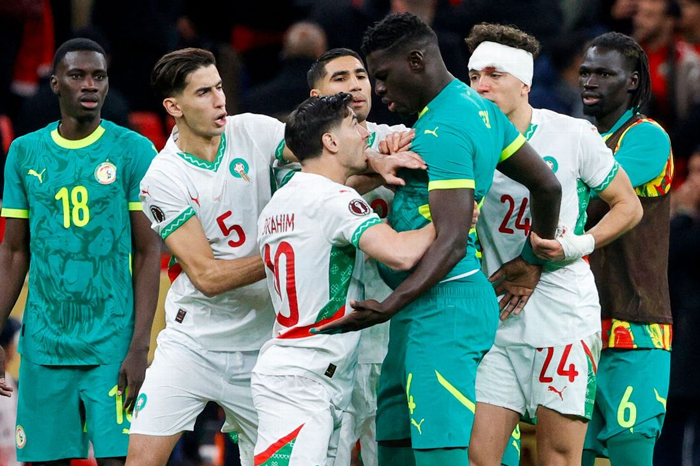
Then came the true drama, both sets of players flooded the zone between the benches arguing over the perceived injustice felt by the Senegalese as the Moroccan contingent insisted it was definitely a penalty. In truth, they probably didn’t need to insist, if they had simply asked the referee for a penalty at the start of the game, he probably would have awarded them one out of courtesy.
After Ndala mimicked a television screen with his hands and pointed to the spot, chaos ensued all around him. The home fans were jubilant as they made more noise than they had made at any point throughout the night, which was a great achievement considering how loud they had been any time a player in green touched the ball. Some Senegal fans tried to storm the pitch and clashed with riot police at the other end of the stadium as their players retreated into the dressing room in protest as Pape Thiaw stormed the field to argue with the bald man wearing an uncomfortable smile looking bewildered as to what he had just caused.
Walid Regragui for his part followed Thiaw into the middle of the pitch to attempt to drag his opposite number back to the technical area and told reporters after the game his Senegalese counterpart did not “honour Africa”, whatever that means? We got pictures of Senegal legend El Hadji Diouf on his phone and Sadio Mané standing alone trying to bring his teammates back onto the grass to finish the game regardless of the outcome.
One friend of this writer sent a text in the middle of the insanity with four simple words; “this is great television” and he wasn’t wrong. Many will call the scenes we saw a variety of words that all ultimately mean “disgraceful” or say it’s harmed the view the wider world has of African football but for 30 minutes on a Sunday night in January, every fan of the game, no matter where they were in the world was glued to two teams vying to be Africa’s best arguing over a penalty. And we hadn’t even reached the peak of the drama.
Eventually we saw Eduoard Mendy appear from the tunnel with his colleagues and take his place on the goalline to face down Real Madrid’s Brahim Díaz in the 24th minute of added time. Díaz has been the golden boy for the Atlas Lions at this tournament with his five goals earning him the Golden Boot before a ball was kicked in the final. Surely, SURELY, he would slot the penalty away and we would all be speaking about the great injustice we had all witnessed at the Prince Moulay Abdellah Stadium?
Brahim Díaz deciding that he was going to attempt to panenka his penalty over Mendy was absurd. It may well go down in history as the worst penalty kick ever taken given the context, it may even beat Roberto Baggio’s attempt in the 1994 World Cup final. It was so incredible that when Mendy gratefully caught the ball without any effort, no player from Senegal celebrated, no Morocco fan or player even reacted, every one just stared in stunned, momentary silence.
Had he missed on purpose? Had the guilt of earning the penalty in the manner he did caused a moral dilemma in the mind of the taker? Was this really the most sporting moment ever seen? It turned out it wasn’t and Díaz did genuinely attempt to panenka a penalty with the last kick of the game to win his nation a first AFCON title since 1976. There’s a fine line between fame and infamy, Brahim Díaz may come to learn that in years to come.
The most insane moment of the most insane game of the season! ??? pic.twitter.com/PaTAMFqBXj
— Bet9ja: The home of #betBOOM! ? (@Bet9jaOfficial) January 19, 2026
Act 3 – The Beautiful Game, Played Beautifully
You could have been forgiven for thinking that the game was done after the mind-blowing 25 minutes of injury-time we sat through but we still had extra-time and potentially a penalty shoot-out to deal with. Nobody seemed capable of making sense of what had unfolded, extra-time started and it felt like nobody noticed.
Torrential rainfall descended on Rabat but there was one man on the pitch that kept his focus and knew how to reach the end of a storm. Sadio Mane had been instrumental in bringing his team back from the bowels of the stadium and he would be instrumental in the goal that won them the grand prize. It may well be the Al Nassr striker’s final AFCON game and he would have already been remembered as a legend prior to kick-off but his impact on this game has cemented that legacy even more.
Pouncing on a loose touch in midfield in the fourth minute of overtime, he overturned the ball in his own half and drove forward before pulling off a delightful backheel that took two Moroccans in close pursuit out of the game. Idrissa Gana Gueye played an incisive forward pass into Pape Gueye’s stride who then held off the challenge of Hakimi and fired into the top corner from the edge of the penalty area.
It was a strike that Gueye dreamed of the night before as he lay in his hotel bed but not even in his wildest dreams did he imagine the circumstances in which it would happen. The reverse camera angle that showed the true beauty of the goal belongs in a museum, he met the ball as it bounced, his laces connected with it like the cleanest right hook Muhammad Ali ever threw and it kissed the crossbar in a way that belongs in the greatest romance movie ever made.
A goal worthy of winning any trophy anywhere! ? pic.twitter.com/bqMBK8hn8g
— Bet9ja: The home of #betBOOM! ? (@Bet9jaOfficial) January 19, 2026
There may have been ugly scenes leading up to it, but this goal was the beautiful moment a final deserves to be settled by.
The term “classic AFCON” is thrown around a lot on social media in a way that is meant to denigrate African football to make it look lesser than its European and South American counterparts but this truly was “classic AFCON” in a way that its European and South American counterparts could never even dream of. It will be remembered forever.